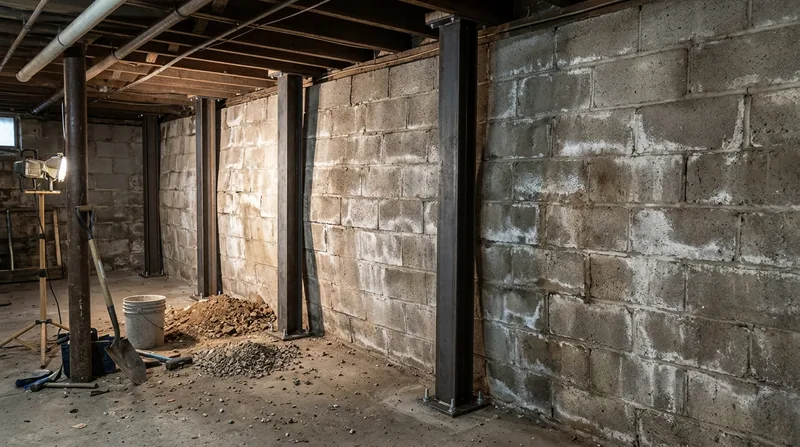




If you own an older home on Kenosha's south side or downtown, you may already know the look: a basement wall that bulges inward a few inches, horizontal cracks in the block, and a floor that no longer meets the wall squarely. Bowing Wall Repair in Kenosha is the trade that stops that movement before it becomes a structural emergency. Our city sits on glacial till and lake-deposited clay over a high water table, so the ground stays wet from late winter into spring, and that saturated clay pushes hard against 1890s brick, stone, and early block foundations. Add frost heave and freeze-thaw cycles working into the walls, and a leaning wall is less a question of if than when. We stabilize bowing and leaning foundation walls with carbon fiber straps, steel I-beams, or wall anchors matched to the severity of the movement and the soil on your lot. For a broader look at how we keep water away from the foundation, see our basement waterproofing service.
Why Bowing Walls Show Up So Often in Kenosha's Older Neighborhoods
The dominant failure mode here is hydrostatic pressure from wet clay bearing against a wall that was never engineered for it. Downtown and south-side two-story homes and foursquares often sit on stone or early block walls with lime mortar that softens as it stays damp. Near the Pike River, 1920s and 1940s bungalows and Cape Cods have partly finished basements where a wall has been quietly moving for decades. West-side 1950s to 1970s brick ranches and split-levels show it in poured or block lower levels, and the lakefront bluff homes at Simmons Island and Southport deal with eroding shoreline under the lower walls. In the newer subdivisions of Pleasant Prairie, Somers, and Bristol, poured full basements are less prone to bowing, but poor grading and short downspout extensions still load the walls.
- Horizontal cracks in the middle third of a block wall signal pressure, not settling, and they need eyes on them quickly.
- A wall that leans inward at the top usually points to frost pushing from outside or soil creeping under the footing.
- White efflorescence and damp patches often come with movement, because water is finding the same path the wall is failing along.
- Sticking windows, doors that no longer latch, and a visible gap at the top of the wall are signs the movement is active.
None of these get better on their own, and the earlier we brace a moving wall, the less steel and excavation the job takes.
Key info: On a 1920s foursquare near downtown Kenosha, a 2-inch inward bow at the top of a block wall is not the same job as a 2-inch bow at mid-height. Top-of-wall movement often traces to frost and soil outside, while mid-wall bulging points to hydrostatic pressure and a failing footing drain. We diagnose which before we quote a repair.
For the Wisconsin building code side of structural repair, the Wisconsin Department of Safety and Professional Services publishes the rules contractors and inspectors work from.
How We Diagnose and Repair a Bowing Wall in Kenosha
We start by finding out why the wall moved, not just where it cracked. That means checking the exterior grade, the downspout extensions, the footing drain, and the water table at your address. Then we measure the bow with a plumb line and a level, map the cracks, and decide whether the wall needs to be stopped, stabilized, or tied back. On a 1950s ranch off Sheridan Road, we might find a blocked footing drain loading a poured wall; on a stone foundation near the Pike River, the fix is often a combination of bracing and getting the water away from the wall. Here is the sequence we follow:
- We inspect the wall from inside and out, measure the bow, and record crack widths and direction.
- We check the drainage: grading, downspout extension length, window well depth, and whether the footing drain still flows.
- We recommend the lightest method that will hold the wall, from carbon fiber straps up to steel I-beams or wall anchors.
- We pull the permit through the local building department when structural repair requires it.
- We install the system, restore the basement finish, and correct the drainage that caused the pressure.
- We re-measure and document the wall after the work so you have a baseline for the future.
Stopping the movement is half the job; relieving the water pressure behind the wall is the other half, which is why we often pair bracing with an interior drain tile system.
Key info: A homeowner in Pleasant Prairie called us about a horizontal crack in a poured wall after a wet spring. The wall had bowed about an inch and a half at mid-height. Carbon fiber straps on the inside held it, and extending the downspouts and re-grading the side yard took the pressure off. No excavation was needed.
Bowing Wall Repair Methods We Use in Kenosha
The right method depends on how far the wall has moved, what it is made of, and what is pushing on it. A stone wall from the 1890s and a poured wall from 1995 do not fail the same way, and they do not get the same repair. We match the approach to the wall and the soil, and we tell you plainly when a simpler fix will hold.
| Approach | Description | Best for |
|---|---|---|
| Carbon fiber straps | Woven straps epoxied to the interior wall surface and anchored top and bottom to stop further inward movement. | Block or poured walls with a bow under about 2 inches and no footing failure. |
| Steel I-beams | Vertical steel beams set against the wall and tied into the floor and joists to resist pressure. | Larger bows, long walls, and stone or block walls that need rigid support. |
| Wall anchors | Steel plates on the exterior soil side connected through the wall to interior plates that pull the wall back. | Walls that have moved several inches and need to be straightened, where exterior access allows. |
| Drainage correction | Grading, downspout extensions, footing drain repair, and interior perimeter drain to relieve hydrostatic pressure. | Any wall where water is the driving force, and as a companion to bracing. |
| Crack injection | Epoxy or polyurethane injection into cracks to seal them and restore some tensile strength. | Stable, non-moving cracks that leak, not active structural movement. |
We choose the method after we see the wall and the soil, not before, because a repair that ignores the pressure behind the wall will not last.
Bowing Wall Repair Cost in Kenosha: What to Expect
Most homeowners want a number before they want a lecture, so here is the honest version. Simple crack injection on a stable wall starts around $600, which is where the pricing begins. A carbon fiber strap system on a typical block wall runs well above that, and steel I-beams or wall anchors on a badly bowed wall run higher still because of the steel, the engineering, and the excavation. Factors that move the price: how far the wall has moved, the wall material (stone is slower to work than poured concrete), whether the footing drain needs repair, access to the wall inside the basement, and whether the job needs a permit and an engineer's stamp. Getting two or three estimates is smart, and so is asking each contractor what they found behind the wall. For a full breakdown, see our pricing page.
Bowing Wall Repair Near Me: How to Choose a Contractor Near Kenosha
When you search for bowing wall repair near me, you will get a mix of general foundation firms, plumbers, and waterproofing specialists. Ask each one the same questions and compare the answers. Confirm they are licensed and insured, ask for the certificate, and check references from jobs in Kenosha County, not just from out of state. Ask who pulls the permit and whether the local building department requires an engineer's letter for structural repair. If you live in a historic district or an HOA, ask about exterior work rules before anyone digs. And ask what they will do about the water, because bracing a wall without fixing the drainage is a temporary fix. You can reach us through our contact page to set up a look at your wall.
Bowing Wall Repair in Kenosha: Pricing Guide
| Service | Price | Details |
|---|---|---|
| Crack injection (stable wall) | Starting at $600 | Epoxy or polyurethane injection for a non-moving leak; price rises with crack length and access. |
| Carbon fiber strap system | Starting at $1,800 | Interior straps anchored top and bottom; price moves with wall length and number of straps. |
| Steel I-beam bracing | Starting at $3,500 | Vertical steel tied into floor and joists; price depends on wall height and beam count. |
| Wall anchor system | On estimate | Exterior excavation and through-wall anchors; needs an on-site look at soil and access. |
| Drainage correction add-on | On estimate | Grading, downspout extensions, or footing drain repair priced after we see the water path. |
| Estimate | Free | Response within 24h at (262) 287-9586, no obligation to book. |
Indicative pricing, the exact cost depends on square footage, finish, and site access. Free personalized estimate within 24h at (262) 287-9586.


