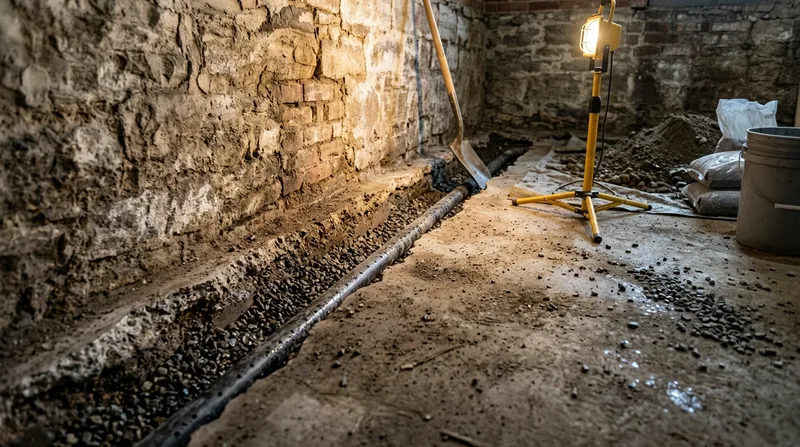




If your basement floor stays damp from February through May, or water pushes up through the slab edge after a heavy rain, you are not alone. The south side and downtown Kenosha are full of 1890s to 1920s brick and frame two-stories sitting on stone and early block walls, and those footings sit in glacial clay over a high water table that never really drops. An Interior Drain Tile System in Kenosha is the fix that works in every season, because we cut the slab, not the yard. We capture water at the footing before it reaches your floor and send it to a sump basin. It is the proven answer for lake clay, and it does not depend on the weather holding.
The Pike River corridor and the low blocks near Simmons Island and Southport take the worst of it. Spring melt and summer downpours push water toward the river and into the low corners of 1920s to 1940s bungalows and Cape Cods. If you are tired of a wet basement every March and a sump pump that quits in July, start with a free basement inspection so we can see where the water is actually entering.
Why Interior Drain Tile Matters in Kenosha's Glacial Clay
Kenosha sits on glacial till and lake-deposited clay, and the ground stays saturated from late winter into spring. That clay holds water against the foundation instead of letting it drain away, so hydrostatic pressure builds under the slab and finds the weakest point: the cove joint where the wall meets the floor, or a cold joint in an old stone wall. When the water table climbs each spring, a basement that was dry all winter can take on an inch of water in a single night.
The building stock makes it worse. Downtown and south side homes often have stone foundations with no footing drain at all, and the 1950s to 1970s brick ranches and split-levels on the west side have poured or block lower levels with original weeping tile that is now collapsed or silted shut. Here is what we see most often:
- Water seeps through the cove joint and pools along the base of the wall after a heavy rain.
- White efflorescence blooms on block walls where moisture moves through the masonry.
- The floor stays damp and a musty basement smell sets in by April.
- The existing drain tile is clogged with clay and silt, so the sump pump runs but the floor still floods.
- Winter freeze-thaw cycles open cracks in the wall that widen a little more every year.
When the water is coming up through the slab and the cove joint, no amount of patching on the inside face of the wall will stop it. That is when an interior perimeter drain is the right call.
Key info: A 1948 bungalow near the Pike River in Kenosha had a wet basement every spring for a decade. The owner had tried hydraulic cement and three coats of sealer. The water was not coming through the wall. It was rising through the cove joint under hydrostatic pressure, and an interior drain tile system with a new sump basin was the only fix that held.
For the official word on what work needs a permit, check the City of Kenosha building department before any structural or drainage work starts.
How We Install an Interior Drain Tile System in Kenosha
We work from the inside, so the job can run in January or July without waiting on the ground to thaw or dry out. The process is the same in a 1920s foursquare downtown and a 1990s poured basement in Pleasant Prairie or Bristol, though the wall type changes how we handle the perimeter. Here is the sequence we follow on every job.
- We walk the basement and mark the high-water lines, efflorescence, and every crack and cold joint before we cut anything.
- We saw-cut a channel roughly 12 inches wide along the perimeter of the slab, tight to the wall.
- We dig down to the footing and remove the old, silted tile where it exists.
- We set new perforated drain tile in washed gravel on the footing, with a slight pitch to the sump basin.
- We install the sump basin at the low corner and connect it to a new sump pump with a check valve.
- We cover the trench with gravel, then concrete, and tie the new pour back to the existing slab.
- We run the discharge line to daylight or a dry well, with a downspout extension so roof water stays away from the foundation.
If the walls show bowing or horizontal cracking from outside pressure, we flag it during the inspection, because drain tile moves water but it does not push a wall back. That is a separate structural conversation.
Key info: In a 1962 split-level off Highway 31 on the west side, the original footing drain had filled with clay and the sump pump was cycling every few minutes during spring melt. We replaced the perimeter tile, reset the basin, and added a battery backup. The homeowner in Somers had been running a shop vac in the basement every March for six years.
For homes in the outlying subdivisions, see our Interior Drain Tile System in Pleasant Prairie page for the poured-basement version of this work.
Interior Drain Tile vs. Other Waterproofing Approaches
Not every wet basement needs the same answer, and we tell homeowners plainly when a simpler fix will do. A single vertical crack that seeps after rain is often solved with epoxy or polyurethane injection for a fraction of the cost of a drain system. But when the water is rising through the slab, coming over the cove joint, or showing up in multiple corners after every storm, injection is a bandage. The table below shows where each approach fits in Kenosha's housing stock.
| Approach | Description | Best for |
|---|---|---|
| Interior perimeter drain tile | Tile set on the footing beneath the slab edge, pitched to a sump basin and pump | Water rising through the cove joint or slab, high water table, any season |
| Exterior footing drain | Tile and gravel placed outside the footing, with membrane and dimple board on the wall | Homes with yard access and a wall that needs exterior membrane work |
| Crack injection | Epoxy or polyurethane forced into a crack through injection ports | A single poured-wall crack that seeps, with no slab or cove joint water |
| Drain tile repair | Clearing or replacing a silted or collapsed existing tile run | A working system that has clogged, in 1950s to 1970s west side homes |
| Sump pump upgrade | New primary pump, check valve, and battery backup on an existing basin | A sound drain system with an old or failing pump |
If you already have a drain system and the pump is the weak link, a battery backup sump pump is the cheapest insurance against a storm-night failure. If the tile itself is silted, we look at drain tile repair before recommending a full replacement.
Interior Drain Tile System Cost in Kenosha: What to Expect
Most interior drain tile work in Kenosha starts around $50 per linear foot, and that figure covers the saw-cut, excavation to the footing, new perforated tile, washed gravel, and the concrete patch. A typical 1,000 square foot basement perimeter runs roughly 140 to 160 linear feet, so the math is easy to do. The final number moves with a few concrete factors, and we would rather tell you now than surprise you later.
- Wall type matters: a stone foundation in a downtown 1890s home takes more care at the footing than a clean poured wall in a Bristol subdivision.
- Basement access matters: a narrow stair and a finished ceiling slow the haul-out and add labor.
- Sump basin and pump are separate line items, and a battery backup adds to the total.
- Discharge routing matters: running the line to daylight is cheaper than a dry well or a long underground run.
- Structural issues found during the cut, such as a bowing wall, change the scope and need to be priced on site.
Get two or three written estimates and compare line by line, not just the bottom number. A quote that leaves out the concrete patch or the discharge line is not a lower price, it is an incomplete one. Our full pricing overview breaks down what each line item includes.
Choosing an Interior Drain Tile Contractor Near Me in Kenosha
Waterproofing is a trade with a lot of one-truck operators and a lot of hard sells. The homeowner's job is to ask the same five questions of every contractor and compare the answers. We would rather you hire the right company, even if it is not us, than get talked into a system you do not need.
- Ask for the license and insurance certificate, and confirm the general liability and workers' comp coverage are current.
- Get at least three written estimates that itemize the tile, the sump basin, the pump, and the concrete patch separately.
- Ask for two or three recent references in Kenosha or Pleasant Prairie and call them, ideally after a spring rain.
- Ask who pulls the permit if the work alters drainage or the sump discharge connection, because the City of Kenosha building department sets the threshold.
- Ask whether the warranty is transferable and get it in writing, because a verbal promise is worth nothing when the pump fails in year four.
If a contractor will not put the scope and the warranty in writing, keep looking. When you are ready to talk through your basement, contact us for a free estimate and we will tell you straight whether you need the full system or a simpler fix.
Interior Drain Tile System in Kenosha: Pricing Guide
| Service | Price | Details |
|---|---|---|
| Interior perimeter drain tile, standard poured or block wall | Starting at $50/linear ft | Includes saw-cut, excavation to footing, perforated tile, washed gravel, and concrete patch along the wall. |
| Stone foundation drain tile, older downtown and south side homes | Starting at $65/linear ft | Includes careful footing work around irregular stone, plus parging touch-up where the wall face is crumbled. |
| Sump basin, pump, and check valve package | Starting at $850 | Includes basin set in gravel, primary pump, check valve, and discharge line stub to the wall. |
| Battery backup sump pump add-on | Starting at $450 | Includes backup pump, battery, charger, and alarm, installed on the new or existing basin. |
| Full basement with structural concerns or bowing wall | On estimate | Needs an on-site look because wall stabilization and drain work are priced as separate scopes. |
| Estimate and travel | Free, included | No call-out or mileage fee in Kenosha and surrounding areas, response within 24 hours. |
Indicative pricing, the exact cost depends on square footage, finish, and site access. Free personalized estimate within 24h at (262) 287-9586.


